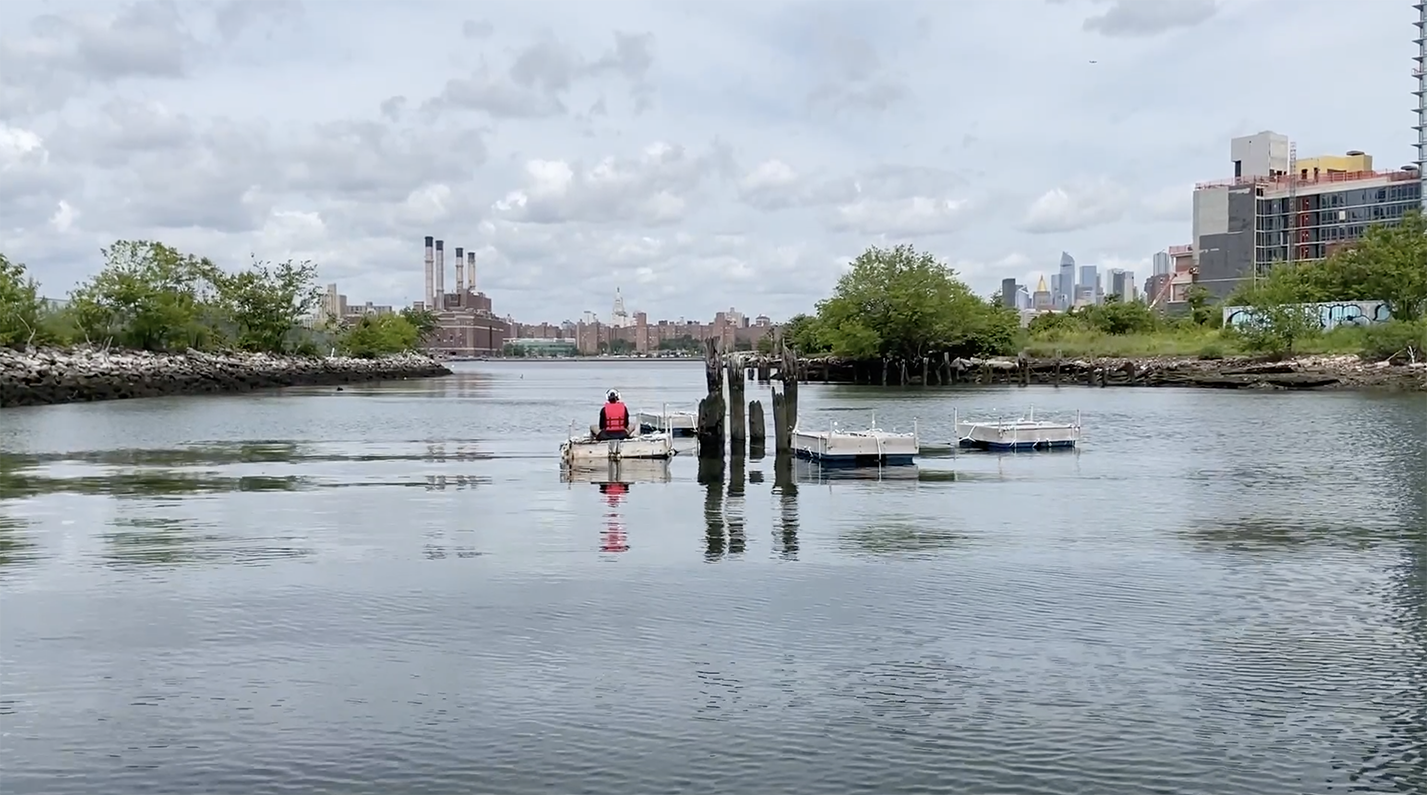
Tending Ostreidae: Serenades for Settling (Version 1) celebrates the listening body of the heroic oyster. Whereas other marine animals use chemical exudates or patterns of light, oysters determine suitable settlement habitats through a distinction of sound signatures in underwater soundscapes. They are also sensitive to loud sounds at certain pitches, which potentially disturbs their reproductive process.
Tending Ostreidae: Serenades for Settling speculatively emulates an oyster’s habitat and the impacts of human noise disruptions, specifically within NYC’s waterways. In the installation, a simulated underwater environment of sound and visuals are generated in real-time, affected by data from local maritime traffic and weather conditions in New York Harbor. In this way the soundscape, composed of local field recordings of an oyster reef and synthesized sound, as well as visualizations, with animated graphics depicting water flows and the oysters’ lifecycle, queries the dynamic relationships between human activity and the wellbeing of oysters.
Together, with sound responsive robotic oysters in sculptural reefs, a dynamically generated visual and aural composition continually responds to the subaqueous sounds of the waterways that play throughout the space.
Through our speculative simulation of this sonically navigating being, and participatory and responsive engagement mechanisms, the artwork animates critical questions, such as: how do we listen for safe harbors, and what do they sound like? Can we amplify new ways to tend to the more-than-human-world and listen for how it tends to us? Can listening with oysters guide us to a politics of mutual tending?

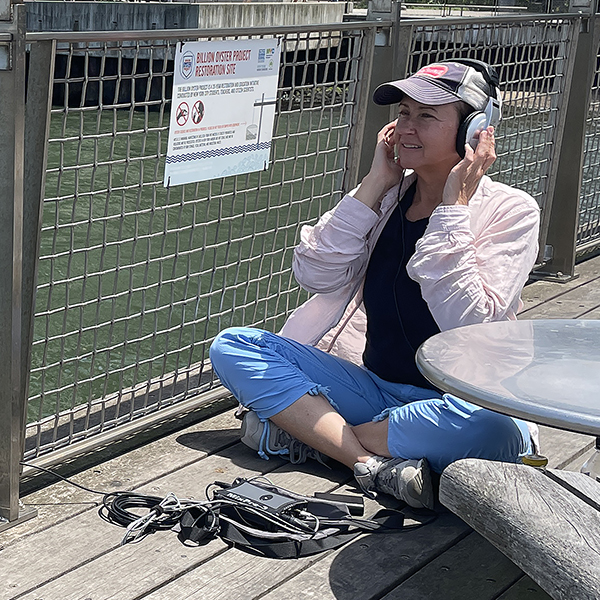
Conceived and developed by Stephanie Rothenberg and Suzanne Thorpe in partnership with the Billion Oyster Project, Professor Karthik Dantu, Director of the Center for Embodied Autonomy and Robotics (CEAR) at University at Buffalo and media artist Silvia Ruzanka. Technical support provided by sound artist Travis Johns.
Project awarded a 2022 Harvestworks Digital Media Arts Center residency and a 2023 New York State Council on the Arts Award (NYSCA). Additional support and funding through the Department of Art at University at Buffalo.